Greaseproof paper is a common auxiliary material in bakery packaging. It is used for food liners, individual product wrapping, food separation, and takeaway packaging. Because different bakery products vary in fat content, moisture, temperature, and surface characteristics, the choice and application of paper also differ. This article introduces the main uses of greaseproof paper, its applications across different bakery products, and practical material selection considerations.
1. What Is Greaseproof Paper in Bakery Packaging?
Greaseproof paper is paper designed to resist the penetration of oils and fats. In food packaging, it acts as a contact layer between the food and the surrounding packaging or container. Its grease resistance comes from the paper's dense fiber structure and, where applicable, surface treatment. The level of resistance varies by product, so paper grades should be matched to the food's fat content and intended use.
In packaging, greaseproof paper can line trays and boxes, wrap individual items, or separate products within a container. Its main function is to reduce direct contact between the food and the packaging material beneath or around it.
Grease resistance, moisture resistance, and heat resistance are separate properties. Grease-resistant paper reduces oil penetration; water-resistant paper has some ability to resist moisture; heat-resistant paper can withstand specific temperature conditions. These properties are not interchangeable. Greaseproof paper also differs from ordinary wrapping paper because it is manufactured with a higher degree of oil and fat resistance. It is suitable for selected bakery applications where fats or buttery surfaces would otherwise mark or weaken ordinary paper, but its suitability depends on the specific product and conditions of use.
2. Common Uses of Greaseproof Paper in Bakery Packaging
2.1 Lining Bakery Trays and Boxes
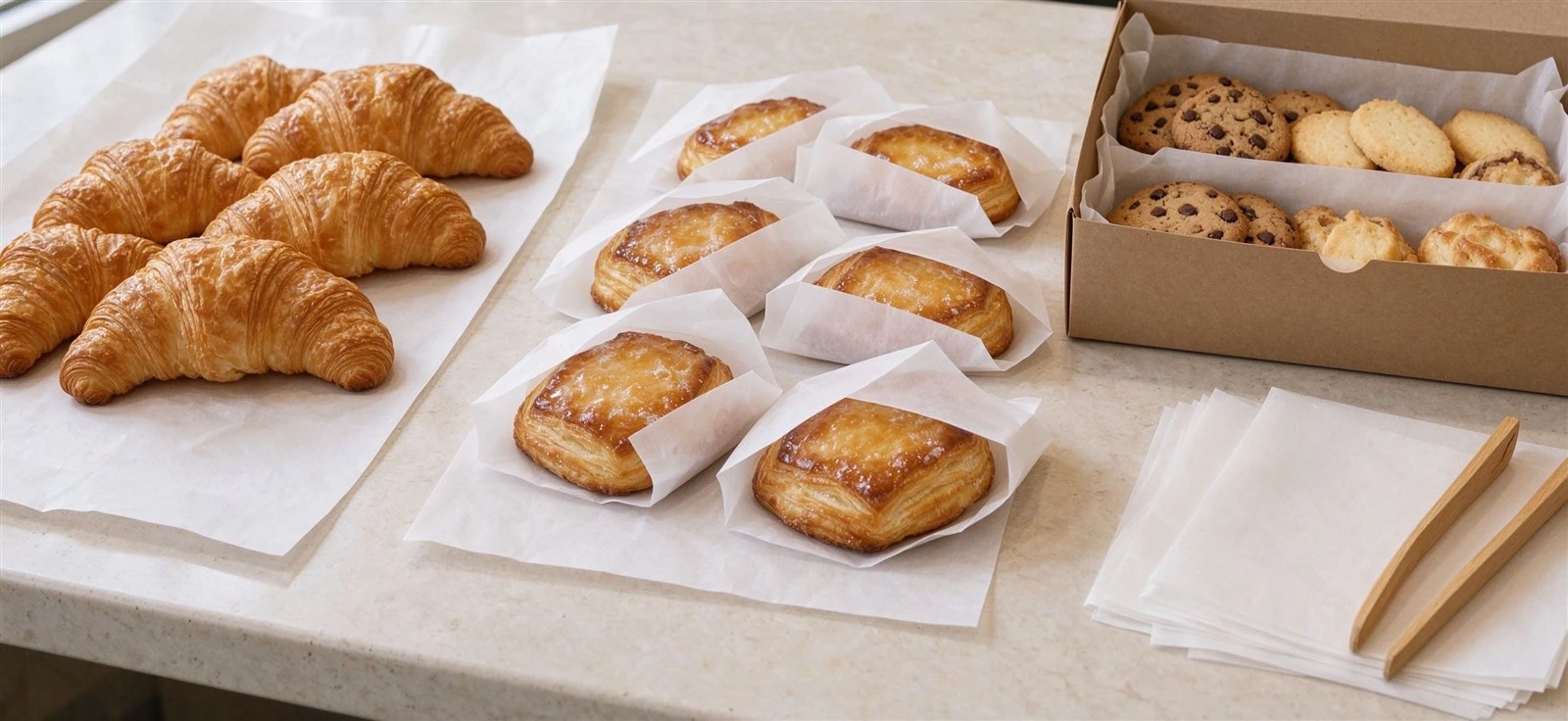
Greaseproof paper is often used as a liner for food trays, pastry boxes, and takeaway containers. A sheet is placed between the food and the container to keep the container cleaner, make food arrangement easier, and simplify removal of products. Lining also improves the overall tidiness of the packaging interior.
2.2 Wrapping Individual Bakery Products
Individual wrapping is common for croissants, Danish pastries, muffins, cookies, and individual pastries. The paper is folded around the product to cover the surface and provide a protective layer. Folding method, coverage area, and ease of handling should be considered so the paper stays in place and the product remains convenient for the customer to take and open.
2.3 Separating Different Bakery Products
Greaseproof paper can be used as a separation layer between different bakery products. Placing paper between pastries reduces direct contact between food surfaces. This is useful in mixed pastry boxes, where different items are arranged together. Separation helps organize the box, makes classification easier, and allows items to be removed individually.
2.4 Supporting Takeaway Bakery Packaging
In takeaway packaging, greaseproof paper supports the outer packaging. Pastries may be wrapped in greaseproof paper before being placed in a paper bag, or paper may be laid inside a pastry box as a liner. Greaseproof paper is an auxiliary packaging material; it does not replace complete outer packaging.
3. How Different Bakery Products Use Greaseproof Paper
3.1 Bread and Bread Rolls
Bread and bread rolls can use greaseproof paper for lining and wrapping. For bread with oily or buttery surfaces, the paper's grease resistance should be considered. If the bread is packed warm, the paper's temperature suitability should be confirmed. If an outer wrapper or bag is used, the paper acts as the inner contact layer, while the outer packaging provides containment and carrying support.
3.2 Croissants and Danish Pastries
Croissants and Danish pastries typically contain butter, making grease resistance important. Greaseproof paper can be used for individual wrapping and as a box liner. Because these products are fragile and may leave grease marks on surfaces, the paper should be folded loosely enough to avoid crushing the pastry while still covering the surface. In boxes, a liner helps keep the base clean and makes removal easier.
3.3 Cookies and Biscuits
For cookies and biscuits, greaseproof paper is often used as a box liner. When products are stacked in multiple layers, paper can be placed between layers to separate them and reduce surface contact. Dry cookies and oily cookies have different requirements: dry products may mainly need separation and handling support, while oily products require closer attention to grease resistance. Stacking pressure and product shape should also be considered.
3.4 Cakes and Sliced Pastries
Cake slices and small pastries can use greaseproof paper as a packaging liner. These products may have soft surfaces and higher moisture levels, so the paper should be selected according to the product's surface and storage conditions. It should not be assumed that standard greaseproof paper will prevent cream from sticking or moisture from penetrating. Where cream, icing, or high moisture is present, the paper specification and the overall packaging combination should be checked.
4. Combining Greaseproof Paper with Other Bakery Packaging Materials
Greaseproof paper is often combined with other packaging materials. In these combinations, the inner paper layer and the outer packaging each perform distinct functions: the paper provides a food-contact layer, helps manage grease and surface contact, and improves presentation; the outer packaging provides containment, structural support, carrying convenience, and protection during transport.
4.1 Greaseproof Paper and Paper Bags
Greaseproof paper can serve as the inner wrapping layer, while a paper bag provides the outer carrying packaging. This combination is suitable for some bakeries and takeaway pastry packaging. The paper contacts the food, and the bag contains the wrapped item for transport.
4.2 Greaseproof Paper and Bakery Boxes
When used with bakery boxes, greaseproof paper functions as an inner liner while the box provides structure and support. This combination is common in mixed pastry boxes and individual pastry boxes. The paper helps keep the box interior cleaner, and the box protects the contents during handling and transport.
4.3 Greaseproof Paper and Other Food Packaging Materials
Depending on food characteristics, greaseproof paper can be combined with other suitable food packaging materials. The inner paper layer handles food contact and surface separation, while the outer material provides containment, rigidity, or barrier properties as needed. Packaging combinations should be selected with reference to food contact requirements and actual storage conditions.
5. How to Choose Greaseproof Paper for Bakery Packaging
5.1 Consider the Grease Content of the Food
Pastries with high butter content have different requirements from dry cookies. The appropriate grease resistance should be selected based on the surface oil and fat conditions of the food. Paper performance should not be judged only by appearance.
5.2 Consider Moisture and Product Texture
The moisture content and texture of the food affect how paper performs in use. Moist pastries and dry cookies have different packaging requirements. Grease resistance does not equal water resistance, so moisture-related needs should be specified separately.
5.3 Consider Paper Thickness and Sheet Size
Paper specifications should match the application. For wrapping, sheet size should allow adequate coverage and secure folding. For tray and box lining, sheet dimensions should fit the container base and sides without excessive overhang or gaps. Paper thickness or basis weight should be appropriate for the food's weight, surface texture, and handling method. Manual wrapping may favor pre-cut sheets, while bulk or automated packaging may require consistent sheet dimensions, reliable feeding, and clean cutting. Different applications may need different specifications.
5.4 Check Food Contact Suitability
Paper intended for direct food contact must meet the food contact requirements applicable to the target market. When purchasing, confirm the relevant material documentation, conditions of use, and any temperature or food-type limitations. Do not assume that all greaseproof papers carry the same certifications or are suitable for all foods.
5.5 Match the Paper to the Packaging Process
Consider how the paper will be handled during daily packaging operations. Manual wrapping, tray lining, and batch packaging may require different paper formats and handling methods. The paper should be convenient for operators to handle, position, and replace without disrupting the packaging workflow.
For bakery applications requiring grease-resistant liners or wrapping materials, explore our greaseproof paper products to review the available options.
6. Common Mistakes When Using Greaseproof Paper
6.1 Assuming Grease Resistance Means Waterproofing
Grease resistance and waterproofing are separate requirements. Both should be specified when the food contains moisture as well as fat.
6.2 Choosing Paper Without Considering the Food Type
Different foods have different fat content, moisture levels, and surface structures. Paper should be selected with these differences in mind.
6.3 Using Unsuitable Paper Sizes
Paper that is too small may not cover the food adequately or may be difficult to fold and secure. Sheet size should match the wrapping or lining task.
6.4 Ignoring Temperature Requirements
Not all greaseproof papers are suitable for high-temperature baking or direct contact with hot food. Product specifications should be confirmed before use in these conditions.
Conclusion
Greaseproof paper serves several important functions in bakery packaging: lining trays and boxes, wrapping individual products, separating different items, and supporting takeaway packaging. When selecting greaseproof paper, consider the food type, grease content, moisture level, paper thickness and sheet size, food contact suitability, and the packaging process. Matching the paper to these practical requirements helps ensure effective use in bakery packaging.
If you wish to purchase relevant products, please contact us.