Plastic twist ties come in different sizes, and length is usually the most important dimension when choosing a tie for a specific bag opening. While other measurements like width and wire diameter also appear in product specifications, length directly determines how far the tie can wrap around a gathered closure and how much material remains for twisting.
A longer tie is not automatically a better choice. The right length depends on the bag opening, the way the material is gathered, and the amount of twisting space needed. This guide explains the basic dimensions, how to measure length, and how to select a suitable size for your packaging needs.
What Are the Main Dimensions of a Plastic Twist Tie?
Every plastic twist tie has three basic physical measurements. The table below summarises what each one means:
| Dimension | What It Means |
|---|---|
| Length | Overall end‑to‑end length of the tie |
| Width | Width of the plastic‑covered portion |
| Wire Diameter | Diameter of the internal wire core |
Plastic twist ties are available in different formats and configurations. If you want to understand how plastic twist ties are classified by wire construction, covering, format, color, and printing, see our guide to [Different Types of Plastic Twist Ties Explained].
How Is Plastic Twist Tie Length Measured?

In product specifications, length generally refers to the overall end‑to‑end length of the finished tie when it is laid straight. This is the value typically shown in catalogues and product specifications.
Why Length Matters When Closing a Bag
Length matters because it affects both the fit and the security of the closure.
- If the tie is too short, it may not wrap fully around the gathered opening, leaving little or no room for twisting. The closure becomes difficult to make and may not hold.
- If the tie is noticeably longer than necessary, it leaves a long tail after twisting. While this does not usually affect function, it can make the package less tidy and may use more material than needed.
The goal is a length that comfortably wraps around the gathered bundle while leaving enough surplus for a secure twist, without creating an unnecessarily long tail.
How to Choose the Right Plastic Twist Tie Length
Choosing a suitable length is straightforward when you follow these practical steps.
1. Consider the Bag Opening
Start with the actual opening that needs to be closed-not the overall bag size, but the portion that will be gathered. Consider how much material will form the gathered neck, rather than relying only on the bag's flat opening width.
Remember that the opening is rarely closed flat; it is usually bunched, folded, or rolled, which changes the effective circumference.
2. Consider How the Bag Is Gathered
The same bag opening can require different tie lengths depending on how you gather the material.
- Tightly gathered – the material is pulled into a narrow neck, so a shorter tie may suffice.
- Folded or rolled – the opening is turned over several times, increasing bulk and requiring more length.
- Loosely gathered – more of the opening remains in the gathered bundle, so additional length may be needed.
There is no fixed formula, but visual estimation of the gathered bundle will guide you toward a suitable range.
3. Leave Enough Length for Twisting
Wrapping the tie around the gathered opening is only half the job-you also need enough remaining material to twist the two ends together securely. A common mistake is to choose a length that just reaches around the bundle, leaving no extra material for the twisting action.
Leave enough additional length beyond the gathered opening to twist the tie comfortably. The amount needed varies with the bag material, gathering method, and tie design, so a fixed extra length (such as 2–3 cm) should not be treated as a universal rule. Instead, allow a margin that feels secure and easy to handle for your specific packaging.
4. Avoid Choosing Excessively Long Ties
While it may seem safe to choose a much longer tie, excessively long products can be less practical:
- They leave a long tail after twisting, which may interfere with stacking or packing.
- Appearance may be less neat, especially for retail‑facing packages.
- Handling can be slightly more cumbersome, and material usage is higher than necessary.
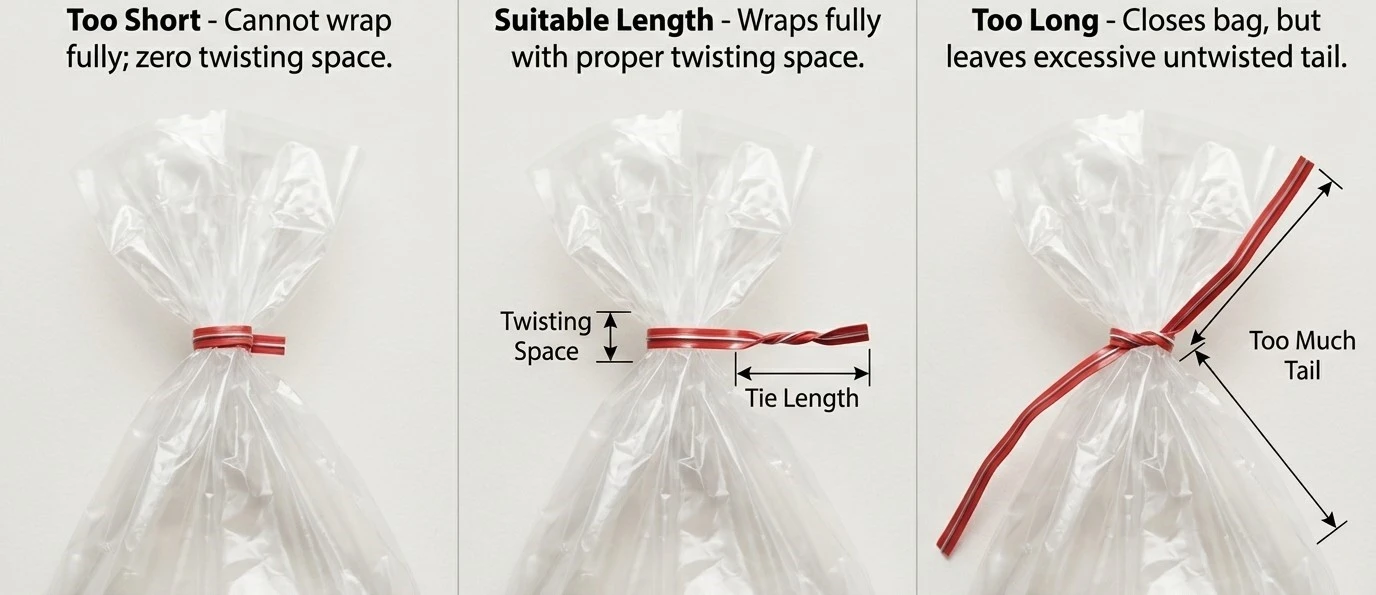
Choose a length that reliably closes the bag while leaving enough room for twisting, without creating an unnecessarily long tail.
Common Plastic Twist Tie Lengths
Plastic twist ties are manufactured in a variety of lengths to suit different packaging formats. Common product specifications may include lengths such as 8 cm, 9 cm, 10 cm, and 12 cm, depending on the product format and intended application.
The table below provides general guidance on how these example lengths relate to typical closure situations. These are examples only, not fixed standards.
| Example Length | General Consideration |
|---|---|
| 8 cm | Suitable for relatively small or tightly gathered openings |
| 9 cm | Suitable for small‑to‑medium closure applications |
| 10 cm | Provides more wrapping and twisting room |
| 12 cm | Useful when additional wrapping length is needed |
These examples are intended as a general reference, not a fixed size‑to‑bag‑opening standard. The actual length required depends on how the bag is gathered and closed. Always verify the actual dimensions available and test samples when possible.
Does a Longer Twist Tie Mean a Better Twist Tie?
No. A longer tie simply provides more available length for wrapping and twisting-it does not indicate better quality, strength, or durability. Whether a longer tie is beneficial depends entirely on the bag opening, the gathering method, and the required twisting space.
For a small, tightly gathered opening, a long tie may be unnecessary and even inconvenient. For a large, loosely filled bag, a longer tie may be essential. The measure of a good choice is suitability, not absolute length.
Length vs. Width vs. Wire Diameter – Quick Summary
The table below recaps the three dimensions and their primary roles:
| Dimension | What It Describes | Why It Matters |
|---|---|---|
| Length | Overall tie length | Determines available wrapping and twisting length |
| Width | Width of the covered tie | Describes the finished tie's physical size |
| Wire Diameter | Diameter of the inner wire | Defines an important specification of the wire core |
Length is the primary factor for fit in most bag‑closing applications; width and wire diameter are separate technical attributes that may be explored when more detailed product selection is needed.
Frequently Asked Questions
What is the most common plastic twist tie length?
There is no single universally common length. Different products and packaging methods use different lengths. The most frequently ordered sizes vary by industry and application, so base your choice on your specific bag and closure method rather than on averages.
How do I know what size twist tie I need?
Start by examining the bag opening, the way you plan to gather it, and how much length you need for a secure twist. Compare your estimate against the available sizes. Sample testing is often the most reliable way to confirm the right fit.
Is a longer plastic twist tie better?
Not necessarily. A longer tie offers more wrapping and twisting length, but that is only an advantage if your bag requires it. For many applications, a moderate length that fits neatly and twists securely is preferable.
Are plastic twist ties available in custom lengths?
Yes, depending on the product format and manufacturing specifications, custom lengths may be available.
What is the difference between twist tie length and wire diameter?
Length is the total measurement of the entire tie from end to end. Wire diameter is the thickness of the internal metal core. They are independent specifications; a tie can be long with a thin wire, or short with a thick wire, depending on the design.
Conclusion
Choosing a plastic twist tie size starts with the bag opening rather than the tie itself. Length determines how much material is available for wrapping and twisting, while width and wire diameter describe other aspects of the finished tie. Once the basic dimensions are understood, the next step is to consider how plastic twist ties are used in different packaging applications.
Next: Common Uses of Plastic Twist Ties in Packaging