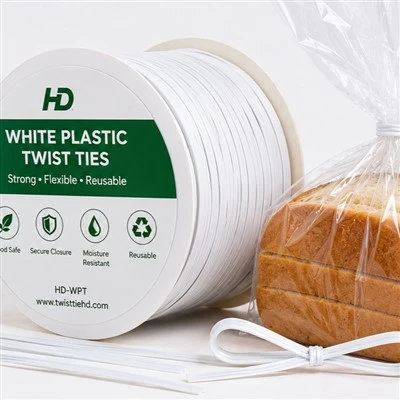
As the baking industry pursues sustainable development, paper bread twist ties are becoming a reliable alternative to traditional plastic closures with their significant environmental advantages and practical performance. This article explores their core value from the perspective of practical application.

1. The practical embodiment of environmental performance
Degradable and compostable properties
Paper-based materials degrade much faster in the natural environment than plastic products, which meets the current demand for degradable materials in waste management. In areas where garbage sorting is implemented, used paper twist ties can be classified as compostable or recyclable garbage for treatment to reduce the environmental burden.
Relatively low carbon footprint
The production process of paper products usually consumes less energy than plastic production and has relatively low carbon emissions. The use of raw materials from sustainably managed forests or fast-growing plants further reduces the impact on the environment and reduces dependence on fossil fuels.
Good recycling compatibility
Paper twist ties can be recycled together with common waste paper and integrated into the existing paper product recycling system. Compared with some small plastic packaging materials that are difficult to recycle or sort, the recycling process is simpler and smoother, which helps to improve the overall recycling rate of packaging.
2. Reliable guarantee of practical functions
Meet basic sealing needs
Modern paper tie-wraps that have been improved in process (such as adding food-grade coatings) have strength and toughness that can meet the sealing requirements of daily bread packaging and can effectively maintain sealing under common temperature and humidity environments.
Adapt to automated production
The production and application equipment of paper tie-wraps has become increasingly mature, and its filling efficiency is comparable to that of plastic tie-wrap equipment, meeting the needs of high-speed production lines in modern baking factories. Its design is also more ergonomic, reducing the repetitive labor intensity of operators.
Wide range of applications
Paper tie-wraps can not only be used for bread at room temperature, but optimized products can also adapt to packaging needs in frozen environments and meet the requirements of different storage conditions such as prefabricated baked goods.
3. Comprehensive consideration of cost-effectiveness
Raw material cost: As the main raw material, paper is usually competitive in cost.
Warehousing and transportation: Paper tie-wraps are light in weight and relatively compact in size, which helps reduce storage space occupation and logistics transportation costs.
Waste disposal: The degradable and recyclable characteristics help reduce the terminal waste disposal costs of enterprises or municipal systems.
Compliance costs: Comply with increasingly stringent plastic restriction regulations at home and abroad, and avoid potential compliance risks and policy penalty costs.
4. Effective improvement of brand value
Responding to environmentally friendly consumption trends: More and more consumers tend to choose brands that use environmentally friendly packaging. The use of paper tie-wraps can effectively enhance the brand image and conform to the concept of green consumption.
Customization and brand exposure: Paper tie-wraps are easy to print and can carry brand logos, product information or slogans, becoming mobile advertising spaces on packaging, enhancing brand recognition and professionalism.
Enhance consumer favorability: The use of environmentally friendly packaging details can win the recognition of consumers who pay attention to sustainability, and help improve brand loyalty and reputation.
Conclusion: A rational and pragmatic choice
Paper tie-wraps show clear advantages in the current wave of packaging upgrades:
Comply with policy directions: Respond to the national "dual carbon" goals and global plastic restriction trends.
Balance environmental protection and cost: While achieving environmental benefits, it has good economic efficiency.
Meet market demand: It meets consumers' growing environmental awareness and preference for sustainable products.
Of course, its application also needs to be continuously optimized, such as improving performance in extremely high humidity environments and developing pure paper-based structures that are easier to recycle. But at this stage, for baking companies seeking practical, environmentally friendly and cost-effective packaging solutions, paper bread ties are a pragmatic choice worthy of serious consideration. When adopting, companies can evaluate and select based on their own product characteristics, supply chain conditions and target market requirements.