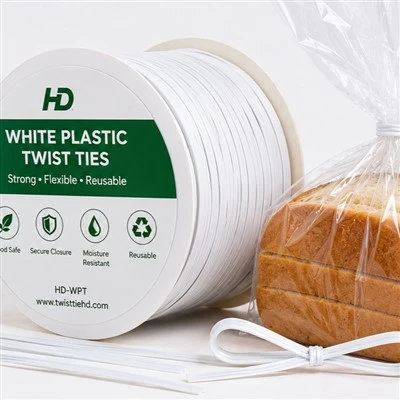
In the wave of the pursuit of packaging sustainability in the baking industry, kraft paper tin ties for baking paper bags (Adhesive Kraft Paper Tin Ties for Baking Paper Bags) stand out due to their unique technical integration. Compared with simply emphasizing the concept of environmental protection, a deep understanding of its technical realization and practical application value can help companies make practical packaging upgrade decisions.

Limitations and technical breakthroughs of traditional sealing methods
Baked food packaging has long faced dual challenges:
Sealing and preservation requirements: Bread, pastries, etc. are prone to moisture and deterioration, requiring tight and reliable sealing.
Repeated opening requirements: Consumers often need to use it multiple times, and the seal must have good re-sealability.
Although traditional plastic ties or disposable seals can partially meet the sealing requirements, they have shortcomings in reusability, recycling compatibility (plastic and paper bags are made of different materials) and environmental protection image. The core innovation of kraft paper self-sealing cable ties lies in:
Precise application of bonding technology: its adhesive backing is not ordinary glue, but an adhesive specially developed for kraft paper substrate (such as the technology described in reference 5), which ensures firm bonding with the surface of baking paper bags to form a stable seal.
Structure and material collaborative design: the flexible kraft paper strip (providing strength and environmentally friendly base) and the highly plastic tinned iron wire (providing the function of repeated bending and shaping) are compounded through mature processes to achieve "one-time bonding, multiple opening and closing".
Core advantages in practical applications
Improve packaging efficiency and reliability:
Simplify operation: In production lines or manual packaging, you only need to peel off the adhesive protective layer and press it on the bag opening to complete the sealing, which is faster than traditional threading cable ties or heat sealing.
Sealing consistency: The bonding technology ensures uniform sealing force each time, reduces the risk of poor sealing due to differences in manual operation, and effectively locks in the freshness and flavor of baked goods.
Optimize user experience and product value:
Convenient opening and closing: Users can easily open the package by bending the iron wire, and rely on the "memory" of the iron wire to reclose the bag, which greatly facilitates multiple uses in home or retail environments.
Enhance brand texture: The natural texture and color of kraft paper can better convey the image of "natural", "handmade" and "high-quality" baking products than plastic seals, which is in line with the current consumer aesthetic trend.
Effectively promote the implementation of sustainable goals:
Material homogeneity is conducive to recycling: kraft paper tie-wraps and kraft paper bags (or similar paper packaging) are made of the same material. After being discarded, they can be recycled or industrially composted without separation (subject to local facility conditions), which technically reduces plastic pollution.
Substantial reduction of plastic: Directly replaces traditional plastic tie-wraps or plastic composite sealing strips, reducing the proportion of non-degradable materials in packaging.
Key considerations for enterprise adoption
Adaptability verification:
It is necessary to test the thickness of the tie-wrap and the bonding effect of the surface treatment (such as lamination) of the existing baking paper bag to ensure its firmness under actual temperature and humidity conditions.
Evaluate its long-term tolerance to different contents (such as pastries with high oil content).
Cost-benefit balance:
Although the unit cost may be higher than that of ordinary plastic cable ties, the long-term benefits brought by it, such as improved efficiency (reduced operation time), enhanced brand value (attracting environmentally friendly consumers), and reduced potential packaging waste disposal costs, should be considered comprehensively.
Supply chain integration:
Closely communicate with suppliers (such as Hongda Packaging, which provides this product, hongda@twistties.cn) to ensure that the specifications (width, length, iron wire strength, adhesive performance) meet the packaging requirements of their own products and can be supplied stably.
Explore the possibility of customization (such as brand LOGO printing) to strengthen brand recognition while achieving functions.
Conclusion: A pragmatic choice under technology empowerment
The kraft paper self-sealing cable tie for baking paper bags is not only a symbol of environmental protection concept, but its value lies in providing a pragmatic solution to the actual pain points of baking packaging (sealing, opening and closing, preservation, image) through mature material composite technology and bonding process. It cleverly combines the sustainable properties of kraft paper with the functionality of metal wire, showing significant advantages in terms of ease of operation, consumer experience and terminal recycling. For baking companies seeking to upgrade their packaging, a deep understanding of its technical implementation path and application value is a key step in evaluating whether it is suitable for them and effectively promoting sustainable packaging transformation. This product represents a reliable and immediately implementable solution that takes into account both functionality and environmental protection under existing technical conditions.