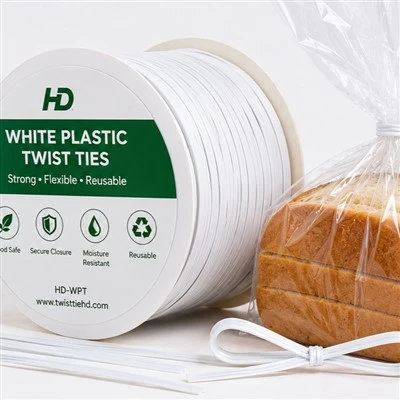
In hardware processing or automotive parts warehouses, the categorized storage of various sizes of hoses, cables, and metal tubing has always been a challenge. Improper bundling not only takes up excessive space but can also lead to accidents during handling. Ordinary office-grade cable ties often spring open instantly when faced with industrial tubing, which has a certain degree of resilience, due to insufficient tensile strength. The emergence of industrial-grade reinforced plastic ties provides a cost-effective solution for this niche market.
## Mechanical Challenges in Industrial Bundling
Tubling is completely different from food packaging; its core challenge lies in "continuous radial tension." Hoses have a strong tendency to straighten after being coiled, placing extremely high demands on the core diameter of the cable tie and the creep resistance of the outer plastic layer. If the inner core of the cable tie is too thin, it will undergo plastic deformation under tension, leading to loosening; if the outer plastic layer is of poor quality, it will be punctured by the edge of the pipe, causing internal corrosion.
## Technical Features of Reinforced Plastic Cable Ties
- Core Strength: Utilizes a high-carbon steel core, providing support far exceeding that of ordinary civilian products.
- Surface Friction Coefficient: The specially designed embossed surface increases friction with the pipe, preventing the cable tie from slipping on smooth surfaces.
- UV Resistance: For pipes stored outdoors, reinforced cable ties must contain UV-resistant additives to prevent embrittlement under sunlight.
## Real-World Case Study: A Visual Management Revolution in a Machinery Factory Warehouse
This factory produces tens of thousands of hydraulic systems annually, resulting in a large backlog of spare oil pipes of various specifications in its warehouse. Previously, due to chaotic bundling, material retrieval efficiency was extremely low. By introducing heavy-duty plastic ties of different colors, the factory implemented color-coded management: red for high-pressure pipes and blue for inlet pipes. This method not only makes inventory readily apparent but also, due to the strong binding force of the ties, allows the previously messy pipes to be stored neatly upright like books, saving floor space.
## Industrial Ties Operating Procedures
1. Allow for Tension Allowance: When bundling flexible hoses, avoid extreme tightness; allow approximately 2% for deformation to buffer against thermal expansion and contraction caused by changes in ambient temperature.
2. Number of Twists: For heavy-duty bundling, it is recommended to twist at least 3.5 times to ensure the stability of the mechanical locking.
3. Edge Inspection: Before use, inspect the cut of the ties to ensure they are smooth and free of burrs, preventing scratches on the surface of expensive pipes during bundling.
## FAQ: Frequently Asked Questions about Industrial-Grade Plastic Cable Ties
- Q: Can this cable tie replace nylon cable ties?
A: Twist ties offer the advantage of being reusable and easier to adjust, while nylon cable ties are only locked once.
- Q: What temperature can it withstand?
A: Standard plastic cable ties can operate continuously in environments below 70℃. For higher temperature resistance, a special coating is required.
- Q: Can it be used to bundle metal rods?
A: Absolutely, but a wider specification is recommended to increase the stress area.
- Q: Is this cable tie oil-resistant?
A: Our PE/PVC outer layer has good oil resistance, suitable for machine shop environments.
- Q: Does the cable tie have a pungent odor?
A: Made using virgin plastic granules, it contains no harmful volatile substances.
- Q: How to quickly cut large quantities of cable ties?
A: We provide pre-cut specifications, or you can use our matching automatic cutting and packaging machine.
- Q: What if the pipe surface is slippery?
A: We recommend choosing anti-slip cable ties with serrated surfaces.
- Q: Can I put labels on the cable ties?
A: Yes, the smooth plastic surface is perfect for self-adhesive labels.
- Q: What is the shelf life of the cable ties?
A: Under indoor conditions away from light, their performance can remain stable for 3-5 years.
More Information You Can Contact: hongda@twistties.cn