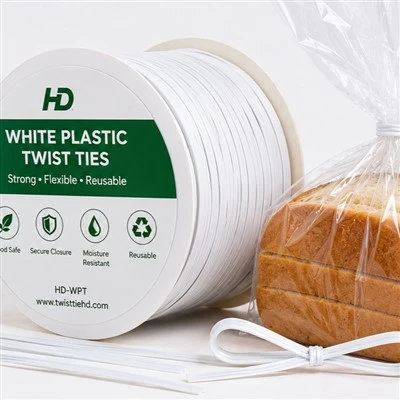
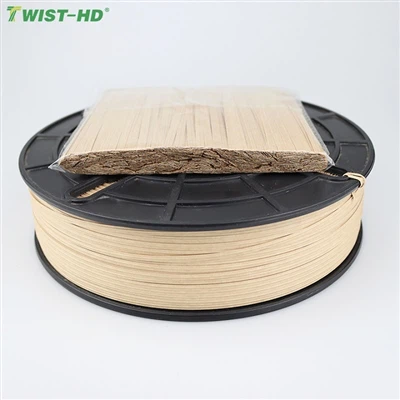
At a time when the packaging industry is pursuing green transformation, PET twist ties are becoming a practical solution to reduce disposable packaging waste due to their reusable characteristics. Compared with traditional sealing methods such as tape and disposable plastic cable ties, PET twist ties provide sustainable options for companies and consumers while ensuring sealing efficiency through material innovation and application scenario adaptation.

1. Reusability: Reduce the life cycle cost of packaging
The core advantage of PET twist ties lies in its durability. The structure of polyethylene-coated steel wire allows it to be repeatedly unbuttoned and resealed, and is not easy to break. For example:
Food industry: bread bags and fresh fruit and vegetable packaging can still maintain sealing after multiple openings and closings, reducing food waste;
Industrial scenarios: repeated packaging of factory parts bags and warehouse turnover boxes to reduce the frequency of consumables procurement;
Home use: gardening bracket fixation, wire sorting and other scenarios can be recycled for a long time.
This feature directly reduces the cost of a single package and relieves the pressure of waste disposal.
2. Evolution of environmentally friendly materials: responding to the industry's demand for plastic reduction
In response to the trend of sustainable packaging, manufacturers are actively promoting material upgrades:
Application of recycled plastics: Some companies (such as Zhenjiang Hongda) use recycled polyethylene to make the outer skin of twisted wire to reduce the consumption of virgin plastic;
Exploration of degradable materials: Experimenting with bio-based material coatings such as polylactic acid (PLA) to achieve controllable degradation under specific conditions;
Lightweight design: By optimizing the diameter of the steel wire and the thickness of the plastic, the amount of raw materials used in a single product is reduced.
These improvements are in line with the environmental protection policy orientation without sacrificing tensile strength and weather resistance.
3. The hidden value of efficiency and safety
The sustainability of PET twisted wire is not only reflected in the material end:
Operational efficiency: Production line workers can quickly tie it up by hand without the assistance of tools, which increases the packaging speed;
Anti-tampering design: The physical structure after twisting forms obvious operating traces to ensure the safety of logistics in the middle;
Classification management: Through color coding (such as red for urgent items and green for perishables), the storage and sorting process is simplified to reduce the rework waste caused by errors and omissions.
4. Future Direction: Closed-loop Recycling and Intelligence
The industry is exploring a more systematic recycling model:
Establishing recycling channels: Cooperating with packaging recycling companies to centrally process waste twisted wires, separate steel wires and plastics for recycling;
Technology empowerment: Printing washable ink labels (such as batch numbers, recycling codes) on the surface of twisted wires, or embedding micro RFID tags to assist in full life cycle tracking.
These practices have been piloted in some food supply chains to accumulate experience for large-scale applications.
Conclusion
The value of PET twisted wire has extended from "functional sealing tools" to "sustainable packaging carriers". Its reusable characteristics directly reduce resource consumption, and the continuous iteration of materials and processes is promoting its integration into the circular economy system. For companies seeking green packaging transformation, this type of durable basic component may become a key link in balancing efficiency, safety and environmental protection.