

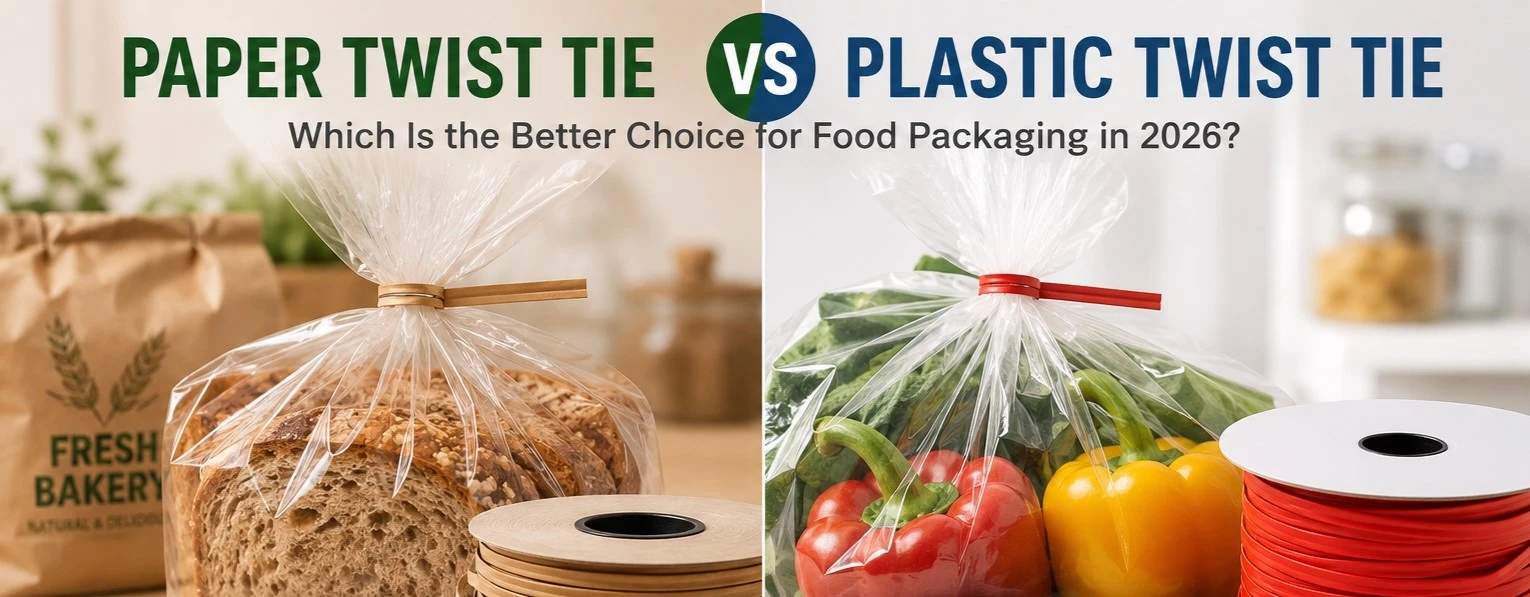
Why Twist Tie Material Selection Matters
Every packaging component contributes to the overall performance of a product. Although twist ties account for only a small portion of packaging costs, selecting the wrong material can lead to production inefficiencies, inconsistent sealing, damaged product presentation, and unnecessary waste.
Professional packaging buyers typically evaluate twist ties based on several key factors:
- Product protection
- Packaging efficiency
- Automation compatibility
- Food safety
- Environmental impact
- Total procurement cost
- Supply reliability
Rather than asking which material is universally better, experienced buyers focus on which material performs best for a specific application.
Understanding Paper Twist Ties
Paper twist ties consist of a flexible metal wire wrapped in kraft paper or coated paper. They are widely used in bakeries, organic food packaging, handcrafted products, and retail applications where a natural appearance enhances brand value.
Advantages
Sustainable Appearance
Paper offers a natural, premium look that aligns well with environmentally conscious branding. Consumers increasingly associate paper packaging with sustainability, making paper twist ties particularly attractive for artisan bakeries and specialty food products.
Excellent Printability
Paper surfaces can be customized with logos, colors, promotional messages, or product information, helping strengthen brand recognition without adding extra labels.
Lightweight and Flexible
Paper twist ties are easy to apply manually and provide sufficient holding strength for many lightweight food products.
Suitable Applications
Paper twist ties are commonly used for:
- Bread bags
- Pastries
- Cookies
- Coffee bags
- Tea packaging
- Organic food packaging
- Gift packaging
Limitations
Despite their visual appeal, paper twist ties are not ideal for every packaging environment.
Potential challenges include:
- Lower moisture resistance
- Faster wear in humid environments
- Reduced durability during repeated opening and closing
- Less suitable for some high-speed automated packaging systems
For operations requiring continuous production or exposure to moisture, buyers often consider alternative materials.
Understanding Plastic Twist Ties
Plastic twist ties are manufactured using plastic-coated materials surrounding a flexible wire core. They are widely used across industrial food packaging, produce packaging, and automated production lines because of their durability and consistent performance.
Advantages
Excellent Moisture Resistance
Plastic coatings provide reliable protection against humidity, making them ideal for refrigerated products, frozen foods, and fresh produce.
Higher Durability
Plastic twist ties retain their shape through repeated opening and resealing, making them suitable for products consumers use over multiple days.
Better Machine Compatibility
Many automatic twist tie machines operate more efficiently with plastic-coated materials due to their consistent surface characteristics and feeding performance.
Cost Efficiency
For high-volume production, plastic twist ties often deliver lower total operating costs because of reduced waste and higher packaging efficiency.
Suitable Applications
Plastic twist ties are widely used for:
- Commercial bakery products
- Industrial food packaging
- Fresh produce
- Frozen food
- Household products
- Industrial bag sealing
Paper Twist Tie vs Plastic Twist Tie
|
Feature |
Paper Twist Tie |
Plastic Twist Tie |
|
Appearance |
Natural, premium |
Clean, modern |
|
Moisture Resistance |
Moderate |
Excellent |
|
Durability |
Moderate |
High |
|
Automation Compatibility |
Good for many applications |
Excellent |
|
Reusability |
Good |
Excellent |
|
Custom Printing |
Excellent |
Excellent |
|
Cost Efficiency |
Moderate |
High for large volumes |
|
Best Applications |
Artisan bakery, premium foods |
Industrial food packaging, bakery automation, produce packaging |
What Packaging Buyers Are Prioritizing in 2026
Packaging trends continue to evolve, but procurement decisions remain practical. Buyers are looking beyond single attributes and evaluating the overall value each packaging component delivers throughout production and distribution.
Performance Before Marketing Claims
While sustainability has become an important purchasing consideration, packaging professionals recognize that environmental goals cannot come at the expense of product protection or operational efficiency.
A twist tie that fails during transportation or interrupts production creates unnecessary waste, additional labor, and higher overall costs. As a result, buyers increasingly prioritize packaging solutions that balance environmental responsibility with dependable performance.
Automation Continues to Expand
Labor shortages and rising operating costs are encouraging manufacturers to invest in automated packaging equipment.
For companies operating high-speed bakery lines, packaging consistency is essential. Twist ties must feed smoothly, twist uniformly, and maintain reliable closure quality without causing interruptions.
Material consistency, wire quality, and dimensional accuracy therefore become just as important as the choice between paper and plastic.
Custom Branding Adds Value
Packaging accessories are increasingly viewed as part of a brand's visual identity. Customized colors, printed logos, and coordinated packaging designs help products stand out on retail shelves while reinforcing brand recognition.
Twist ties have evolved from simple closures into functional branding elements that support a more premium presentation.
Supply Chain Reliability Matters
Global buyers also place greater emphasis on dependable suppliers capable of maintaining consistent quality, supporting custom specifications, and delivering stable lead times. Reliable manufacturing partners reduce procurement risks and help ensure uninterrupted production.
Choosing the Right Twist Tie for Different Industries
Commercial Bakeries
For large-scale bakeries operating automated packaging lines, plastic twist ties are often the preferred choice because they provide consistent machine performance, moisture resistance, and durability.
Premium bakeries targeting eco-conscious consumers, however, may benefit from paper twist ties that complement natural or artisanal branding.
Coffee and Specialty Foods
Both materials can perform well depending on packaging objectives. Paper twist ties create a handcrafted appearance, while plastic twist ties offer greater durability for products exposed to varying storage conditions.
Fresh Produce Packaging
Plastic twist ties are generally more suitable for vegetables and fresh produce because they withstand moisture and frequent handling throughout distribution.
Gift and Retail Packaging
Paper twist ties remain popular for premium retail presentation where visual appeal and sustainability messaging are key purchasing factors.
Beyond Material: Choosing the Right Manufacturing Partner
Selecting the appropriate material is only one part of a successful sourcing strategy. An experienced twist tie manufacturer should also provide:
- Consistent material quality
- Stable wire tolerance
- Custom colors and sizes
- Logo printing services
- OEM and ODM capabilities
- Support for automated packaging equipment
- Reliable international supply
A dependable supplier helps minimize production issues while ensuring that packaging solutions remain consistent across different product lines and markets.
Conclusion
There is no universal answer to the paper versus plastic debate. The best choice depends on your packaging objectives, production environment, target market, and sustainability strategy.
Paper twist ties offer a natural appearance and strong branding opportunities, making them ideal for artisan foods and premium retail packaging. Plastic twist ties provide superior moisture resistance, durability, and compatibility with automated production, making them well suited to large-scale food manufacturing and industrial packaging.
For most B2B buyers, the optimal solution is not simply choosing the most sustainable or the most durable option-it is selecting the material that delivers the best overall balance of performance, efficiency, and long-term value for the intended application.
Frequently Asked Questions
Are paper twist ties environmentally friendly?
Paper twist ties provide a natural appearance and can support sustainability-focused packaging strategies. However, their overall environmental impact depends on the paper source, wire core, local recycling infrastructure, and how the packaging is disposed of.
Are plastic twist ties food-safe?
Yes. When manufactured with food-contact-appropriate materials, plastic twist ties are widely used for bakery, produce, and other food packaging applications. Buyers should confirm compliance with the regulations required in their target markets.
Which twist tie is better for bread bags?
Both materials are suitable. Paper twist ties are often chosen for artisan or premium bakery products, while plastic twist ties are typically preferred for high-volume commercial bakeries because of their durability and compatibility with automated packaging.
Can paper twist ties be used with automatic twist tie machines?
Some paper twist ties are compatible with automated equipment, but performance depends on factors such as material construction, dimensional consistency, and machine specifications. It is advisable to test compatibility before large-scale production.
Can twist ties be customized?
Yes. Manufacturers commonly offer custom lengths, colors, logo printing, spool configurations, and packaging options to meet different branding and production requirements.
How should I choose a twist tie supplier?
Look for a supplier with proven manufacturing experience, consistent quality control, customization capabilities, stable production capacity, and the ability to support your packaging process over the long term.
----------------


