How to Choose the Right Twist Tie for Different Packaging Applications
Choosing the right twist tie involves more than picking a length and color. The application, material, wire gauge, and closure requirements all affect how well the tie performs in daily use. This guide walks through the key factors – from defining your packaging environment to selecting the optimal cover material, wire thickness, and length – so you can make an informed decision that balances function, cost, and user experience.
What Are Twist Ties?
A twist tie consists of a thin metal wire covered with paper, plastic, or another flexible material. The covering makes the tie easy to handle, protects the product from direct wire contact, and allows for printing or color coding. Twist ties are used to close bags, bundle items, and secure lightweight products where a resealable or adjustable closure is needed.
The choice of cover material, wire gauge, and length determines how the tie behaves in a given application.
Different Applications
Bread Packaging
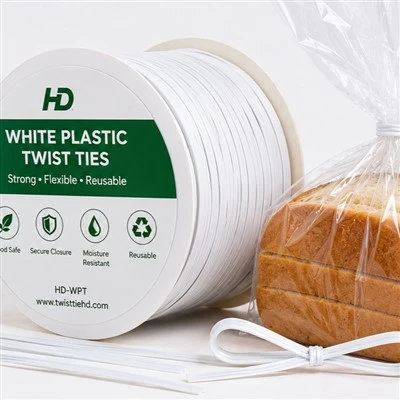
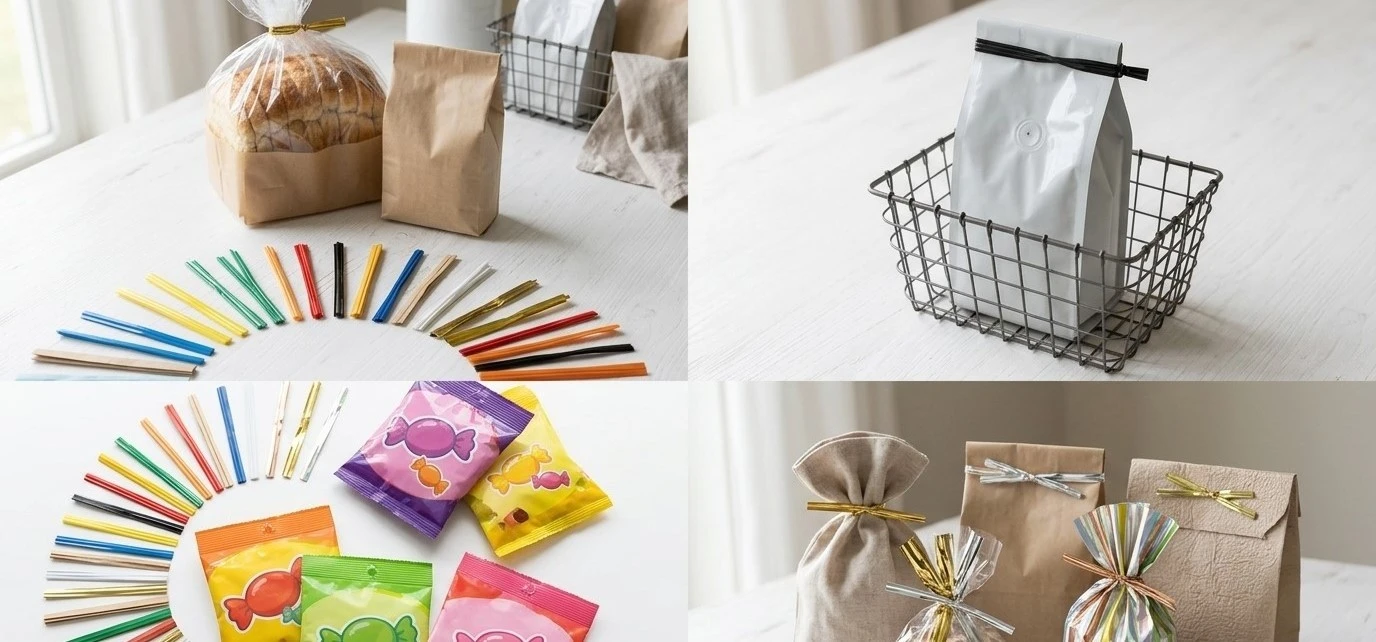
Bread bags require a closure that is easy for consumers to open and reseal multiple times. Twist ties for bread packaging are usually lightweight and flexible. The tie should be long enough to wrap around the gathered bag neck and twist securely without being difficult to handle. Paper twist ties are commonly used here because they can be printed with product information or branding.
Recommendation: Paper-covered ties are typically suitable for bread packaging due to their printability and soft handling.
Coffee Packaging
Coffee bags often need a tighter seal to preserve freshness. Twist ties for coffee packaging may need to resist moisture and oil from the beans. Plastic or PET‑covered ties can offer better moisture resistance than standard paper in some conditions. The wire should hold its shape after twisting so the bag stays closed between uses.
Recommendation: For coffee, consider plastic or PET‑covered ties; select a gauge that provides adequate holding strength while remaining easy for consumers to reopen and reclose.
Bakery
For pastries, rolls, and other bakery items, twist ties often serve both functional and branding purposes. Printed paper twist ties are widely used because they can carry logos, ingredient information, or date codes. The tie should be soft enough to twist by hand but strong enough to stay closed during display and transport.
Recommendation: Paper ties with custom printing are ideal for bakery items, provided the packaging environment is not overly greasy.
Candy
Small candy bags and pouches usually need short, lightweight twist ties. Color can be important here for visual appeal or product differentiation. Since candy packaging is often handled frequently, the tie should be easy to remove and reapply without tearing the bag.
Recommendation: Short, colorful paper or plastic ties work well for candy; choose a thin wire gauge for easy handling.
Gift Bags
Gift bags and decorative packaging often use twist ties as part of the presentation. Color, finish, and flexibility matter more than heavy-duty holding strength. Paper and plastic ties in a range of colors are typically suitable. The tie should look clean and intentional, without sharp exposed wire ends.
Recommendation: Lightweight paper or plastic ties in decorative colors are recommended for gift applications.
Gardening
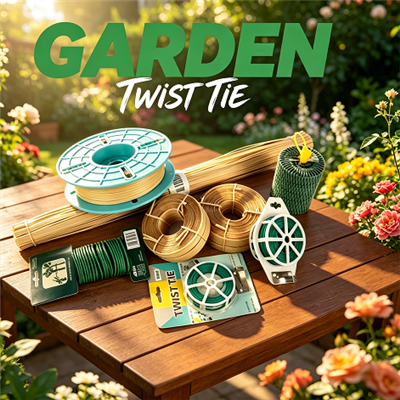
Gardening applications, such as tying plants to stakes or securing vines, require a more durable tie. The tie may be exposed to moisture, sunlight, and repeated handling. Plastic or PET‑covered ties with a heavier wire gauge generally hold up better outdoors. Length is usually longer to allow wrapping around stems and supports.
Recommendation: Choose PET or heavy‑duty plastic ties with a thick wire gauge and longer length for outdoor gardening use.
Cable Organization
For bundling cables and cords, the tie needs to be strong enough to hold weight and resist repeated use. A heavier wire gauge and a durable covering such as plastic or PET are often preferred. The tie should be easy to wrap and untwist without kinking or breaking.
Recommendation: PET‑covered ties with a heavy gauge wire are commonly used for cable management due to their strength and reusability.

Application Recommendation Table
| Application | Recommended Cover Material | Recommended Wire Gauge | Typical Length Guidance |
|---|---|---|---|
| Bread | Paper (printed) | Thin to medium | Short to medium |
| Coffee | Plastic or PET | Medium | Short to medium |
| Bakery | Paper (printed) | Thin to medium | Short to medium |
| Candy | Paper or plastic | Thin | Short |
| Gift Bags | Paper or plastic (colored) | Thin | Short to medium |
| Gardening | PET or heavy plastic | Heavy | Long |
| Cable Management | PET | Heavy | Medium to long |
General guidance only; actual selection depends on product weight, bag dimensions, and packaging requirements. Always verify with sample testing.
Material Comparison
| Property | Paper | Plastic | PET |
|---|---|---|---|
| Moisture Resistance | Low (unless coated/waxed) | Good | Generally higher |
| Durability | Moderate – prone to tearing | High – resists tearing | Typically higher – tough and smooth |
| Printability | Excellent – ideal for logos | Good – available in colors | Moderate – smooth surface |
| Typical Applications | Bread, bakery, candy, gifts | Produce, coffee, general use | Gardening, cables, demanding environments |
| Relative Cost | Generally lower | Generally moderate | Generally higher |
Each material has trade-offs. The appropriate choice depends on the product, packaging environment, and whether the tie is purely functional or also serves a branding role. For detailed specifications, refer to our paper twist tie spools page or contact us to discuss plastic or PET alternatives.
Wire Gauge
The wire gauge affects how much force is needed to twist the tie and how firmly it holds the closure. Thinner wire is easier to twist and works well for lightweight bags and small items. Heavier wire provides stronger retention and is better suited to heavier bundles or applications where the tie will be reused.
When selecting a gauge, consider the following factors:
- Product weight – heavier products demand a thicker wire to prevent loosening.
- Frequency of reopening – ties that will be opened and reclosed many times (e.g., bread, coffee) may benefit from an appropriate gauge that balances ease of use and shape retention.
- Packaging style – if the bag neck is large or the bundle is bulky, a thicker wire helps maintain a firm hold.
- Handling by end‑users – for consumer products, avoid gauges that are too stiff for comfortable hand twisting.
A tie that is too thin may not hold securely; one that is too thick can be difficult for consumers to twist by hand. Testing with actual samples is the best way to confirm the right gauge.
Length
The required length depends on the circumference of the closed bag or bundle and the desired number of twists. A simple way to determine length is to close a sample bag or bundle as it will be used in production, twist the tie as intended, and measure the amount of material used. Add a small handling allowance and test on multiple samples before finalizing the specification.
Additional factors that influence length:
- Bag neck size – larger openings require longer ties to wrap around and secure.
- Number of twists – more twists improve security but need extra length. Twist until the closure is secure without damaging the packaging; avoid over‑tightening.
- Automated packaging equipment – if using spool‑fed machines, the cutter setting may impose minimum or maximum length limits; check machine compatibility.
- Bundle diameter – for bundling multiple items (cables, plants), measure the total circumference and allow extra length for wrapping.
For pre-cut ties, length is fixed and must match the application closely. For spool-fed operations, the operator or machine can cut to the required length.
Pre-Cut vs. Spool Twist Ties – Which to Choose?
| Feature | Pre-Cut Ties | Spool (Continuous) Ties |
|---|---|---|
| Length flexibility | Fixed length; cannot be changed | Adjustable – cut to any desired length |
| Ease of use | Ready to use, no cutting required | Requires cutting (manual or machine) |
| Best for | Small volumes, manual packing, retail | High‑volume production, automated lines |
| Waste | Minimal if length matches exactly | Can be optimized to reduce off‑cut waste |
| Cost efficiency | Generally lower for small orders; depends on volume | More economical at scale; depends on production volume |
| Custom printing | Available on each pre‑cut tie | Possible but more complex on spools |
- Pre‑cut is a common choice when your packaging line is manual, volumes are moderate, or you need consistent branding on each tie without additional cutting steps.
- Spool is typically used when you employ automatic bagging machinery, require variable lengths for different products, or want to minimise inventory SKUs.
Engineering Practice – Real‑World Considerations
Beyond material and dimension selection, several practical factors can make or break the performance of twist ties on a production line:
- Automated feeder tuning – When using spool‑fed ties on high‑speed bagging machines, the feeding mechanism must be calibrated to the tie's cover material and wire stiffness. Softer paper covers may snag if the feed rollers are too tight, while overly stiff plastic can cause misfeeds. Always run a trial with your specific equipment before committing to a large order.
- Sample testing under line conditions – A tie that works well in a bench test may fail when subjected to the vibration, tension, or speed of an actual packaging line. We recommend running production‑representative trials under actual operating conditions – for example, a full production shift or a statistically significant batch size – to observe breakage, twisting consistency, and closure integrity. This is especially critical for automated operations where even a low failure rate can cause significant downtime.
- Environmental simulation – If your product will be stored in refrigerated, high‑humidity, or greasy environments, precondition the packaged samples (e.g., in a cold room or under temperature cycling) before testing the tie's holding force. Performance may vary depending on the material formulation and application environment – for instance, some plastics may stiffen at low temperatures, while PET typically offers a broad operating range, but this should be verified with the specific product you are evaluating.
- End‑user ergonomics – For consumer products, consider evaluating ease of handling with representative users when consumer convenience is important. A tie that is difficult to twist or untwist can lead to complaints and returns, so gathering feedback early can help fine‑tune the gauge and length.
Incorporating these engineering checks early in the selection process reduces the risk of costly re‑specifications after launch.
How to Select – A Quick Checklist
- Define the application – What is being closed/bundled? What conditions (moisture, grease, outdoor, handling frequency)?
- Choose the cover material – Use the material comparison table above to match properties to your environment.
- Select the wire gauge – Consider product weight, reusability, and user convenience.
- Determine the length – Test with actual samples; account for bag neck size, twists, and equipment limits.
- Decide supply format – Pre‑cut or spool? See the comparison table.
- Test before bulk ordering – Run production‑representative trials through your actual packaging process (including automated feeding if applicable) and simulate storage conditions to confirm performance.
Quick Selection Reference Table
| Application Need | Common Material Choice | Common Gauge Choice | Typical Format |
|---|---|---|---|
| Dry food with branding (bread, bakery) | Paper | Thin to medium | Pre‑cut (printed) |
| Moist/oily food (coffee, produce) | Plastic or PET | Medium | Spool or pre‑cut |
| Decorative/gift | Paper or colored plastic | Thin | Pre‑cut |
| Outdoor/gardening | PET | Heavy | Spool (long) |
| Cable bundling / repeated use | PET | Heavy | Spool |
| High‑speed automatic bagging | Machine‑compatible paper, plastic, or PET | Medium to heavy | Spool (machine‑ready) |
The table above indicates commonly used choices, not rigid requirements. Your specific application may warrant a different combination – always verify with testing.
Common Mistakes to Avoid
- Choosing the wrong material for the environment. A standard paper tie may fail in damp or greasy conditions unless properly coated.
- Using wire that is too thin. The tie may not hold securely, leading to reopened bags or loose bundles.
- Cutting ties too short. Insufficient length makes twisting difficult and increases rework.
- Ignoring food contact regulations. For food packaging, confirm that the tie material and any printing are compliant with applicable food‑contact regulations in your target market (e.g., FDA, EU, or local standards).
- Skipping sample testing. A tie that works in theory may not perform as expected in a real production line – always test with your actual packaging equipment and environment.
- Ignoring machine compatibility. Spool ties must match the feeder and cutter specifications of your automated equipment; mismatch can cause jams or inconsistent lengths.
- Choosing appearance over performance. A colourful or custom‑printed tie is useless if it fails to keep the package closed – prioritise functional requirements first.
- Overlooking the impact of storage temperature. Ties that perform well at room temperature may become too stiff or too soft under extreme cold or heat – simulate your supply chain conditions.
Frequently Asked Questions
Q: What is the difference between paper and plastic twist ties?
A: Paper twist ties offer good printability and a natural feel, while plastic ties generally provide better moisture resistance and durability. The right choice depends on the product and packaging environment.
Q: Can twist ties be printed with a logo or text?
A: Custom printing, colors, and paper constructions may be available depending on the specification and order requirements. Contact us with your design requirements for confirmation.
Q: How do I determine the right length for my application?
A: Close a sample bag or bundle as you normally would, twist the tie until secure, and measure the material used. Add a small handling allowance and test on multiple samples before ordering.
Q: What wire gauge should I use for heavier items?
A: The appropriate gauge depends on the weight and holding strength required. For heavier or reusable applications, a thicker wire generally provides better retention. Testing with samples is the most reliable way to confirm.
Q: Should I choose pre‑cut or spool twist ties?
A: Pre‑cut ties are convenient for manual packing and small volumes; spool ties offer length flexibility and are better suited to automated, high‑volume production. See the comparison section above for more details.
Q: Are samples available before bulk ordering?
A: Sample availability depends on the specification. Contact our technical team with your application details to discuss sampling options.
Next Steps
If you need help selecting the right twist tie for your packaging application, contact our technical team with your product type, bag or bundle dimensions, and any special requirements (e.g., moisture exposure, printing needs, machine speed). We can recommend a suitable material, wire gauge, and length, and arrange samples for testing where available. Share your application details for tailored recommendations and sample evaluation.You can also browse our **twist tie product range** to compare available materials and supply formats.
Twist-HD Packaging Solutions
Email: hongda@twisttie.cn