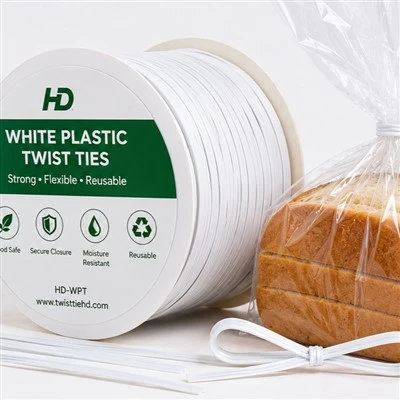
Under the global wave of pursuing sustainable development, the food packaging industry is undergoing profound changes. Among them, the emergence of seemingly tiny degradable bread clips (used to seal bread bags) is not only a manifestation of environmental awareness, but also a specific and subtle signal that the industry chain is upgrading in a more responsible direction. Compared with traditional plastic clips, its promotion is not a smooth road, but it contains practical value in promoting the progress of the industry.

1. Driving force and pressure of industrial upgrading
Traditional plastic bread clips (usually made of HDPE) have long dominated the market due to their low cost and stable performance. However, their environmental legacy problems are becoming increasingly prominent: their difficult-to-degrade properties cause them to exist in landfills or natural environments for a long time, and after fragmentation, they form microplastic pollution and pose a potential threat to wildlife. These environmental costs are gradually being recognized by society, regulations and downstream customers (such as large supermarket chains and bakeries that focus on brand image).
Environmental protection demands from downstream retailers and consumers are forming a reverse pressure mechanism. More and more food retailers are beginning to incorporate packaging sustainability into their supplier evaluation systems, seeking more environmentally friendly solutions to enhance their brand image and meet consumer expectations. At the same time, some regions have introduced or are planning to restrict single-use plastic packaging. This dual pressure from the market and regulation forces upstream packaging suppliers (such as bread buckle manufacturers) to actively explore and provide environmentally friendly alternatives.
2. Degradable clips: a balance between advantages and reality
The core advantage of degradable bread clips (usually made of plant-based materials such as corn starch and potato starch) lies in their predictable environmental fate: under suitable conditions (such as industrial composting facilities), they can be decomposed into harmless substances in a relatively short period of time, greatly reducing the long-term environmental footprint. This is in line with the direction of industrial chain upgrading.
However, the key challenge facing promotion lies in the balance of cost-effectiveness:
Difference in production costs: At present, the cost of degradable materials (such as PLA, PBAT and their composites) is generally higher than that of traditional plastics (such as HDPE). This makes the production cost of a single degradable buckle usually higher than that of a plastic buckle. For baking companies and packaging suppliers with limited profit margins, this is the most realistic consideration.
The scale effect is yet to be formed: The current market demand for degradable clips is relatively small, and the production scale is limited, so the unit cost cannot be diluted like mature plastic products. The investment in production equipment and the optimization of processes require time and money.
Long-term environmental cost considerations: Although the short-term financial cost is high, the introduction of degradable clips can help companies avoid potential future plastic pollution control costs, brand reputation risks (such as negative public opinion caused by plastic pollution problems), and compliance costs that may increase due to stricter environmental regulations. This is an investment for the future.
3. Consumer awareness: The key link in promotion
The environmental value of degradable clips ultimately needs to be realized through consumer acceptance and proper disposal. However, there is a significant cognitive gap in reality:
Perceived value ambiguity: It may be difficult for ordinary consumers to notice or understand the significance of a small buckle changing from plastic to degradable, and it is difficult to directly associate it with specific environmental benefits (such as reducing microplastics).
Lack of disposal knowledge: One of the biggest challenges is that consumers often do not know how to properly dispose of degradable clips. They are usually not suitable for home composting (industrial composting conditions are required), and if mixed into ordinary plastic recycling streams, they will pollute the recycling chain. If it is discarded at will, its degradation rate will be greatly reduced in non-ideal environments.
Information transmission barriers: How to clearly and accurately convey the "degradable" attributes, material composition (to avoid "pseudo-degradation" confusion) and clear disposal instructions (such as "Please put it in an industrial compost bin" or "If there is no composting facility, please dispose of it with ordinary garbage") in the limited product packaging space is a communication problem faced by brands and manufacturers. Excessive publicity or vague information may lead to "greenwashing" suspicion.
4. Pragmatic promotion: multi-party collaboration and continuous improvement
Promoting the application of degradable bread clips requires the concerted efforts of all links in the industrial chain:
Continuous innovation of suppliers: Packaging material suppliers (such as our [company name, which can be replaced by "related enterprises" or directly use the company logo corresponding to hongda@twistties.cn]) need to continuously invest in research and development, optimize the formulation of degradable materials (improve strength and moisture resistance to match bread packaging needs), improve production processes, reduce costs, and ensure the true degradability of materials (in compliance with international/national standards).
Careful selection and communication by brands/baking companies: After evaluating the cost increase, brand value, and long-term risks, degradable clips can be gradually introduced, with priority given to positioning high-end environmentally friendly product lines or responding to key customer requirements. At the same time, resources should be invested in consumer education, and the environmental protection intention and correct disposal methods of replacing clips should be clearly explained on packaging, social media, or in stores to enhance transparency and credibility.
Improve recycling and processing infrastructure: The government and relevant agencies need to accelerate the construction and popularization of industrial composting facilities, and establish a clear classification guidance system to give degradable packaging a "home".
Policy guidance: The government can create a fairer competitive environment for industrial chain upgrading by subsidizing research and development, giving tax incentives to companies that use environmentally friendly packaging, or levying environmental taxes on specific plastic packaging.
Conclusion: The only way to more responsible packaging
The promotion of degradable bread clips is far from a simple product replacement. It reflects the multiple realistic challenges faced by the food packaging industry on the road to sustainable development, such as cost, technology, cognition, and infrastructure. Although there are objective problems such as high costs and insufficient consumer awareness in the short term, it represents the efforts of the industry chain to upgrade towards reducing environmental burden and assuming more social responsibilities.
More Information You Can Contact: hongda@twistties.cn